A budget built for a decade, not just a year
SF: A 56% rise in education spending, a near doubling of health funding and major business reforms suggest it is a budget written for the next decade

Finance Minister Amir Khosru Mahmud Chowdhury walked into the Jatiya Sangsad on Thursday carrying a document that was unprecedented in scope, architecturally coherent in design, and, in several specific areas, technically ambitious beyond anything Bangladesh has attempted through a single budget.
At Tk 9.38 lakh crore, 13.7% of GDP and a 19% expansion over the current revised budget, the FY2026-27 budget is the largest in Bangladesh's history. But for once, the number is the least interesting thing about it.
The budget deficit is projected at Tk 2.43 lakh crore, equivalent to 3.6 %of GDP.
 Keep updated, follow The Business Standard's Google news channel
The revenue target is Tk 6.95 lakh crore, of which Tk 6.04 lakh crore falls on the National Board of Revenue.
Together, these figures are meant to show that the government can increase spending without losing fiscal discipline.
The budget deficit remains below 5% of GDP, a threshold widely considered manageable. At the same time, the government is aiming to raise tax collection. If successful, this would help move Bangladesh's tax-to-GDP ratio closer to 10%, a benchmark the IMF considers important for sustainable development financing.
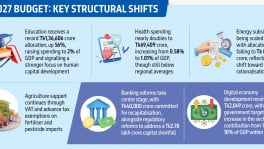
Health delivers arguably the budget's most dramatic single-sector move. The Ministry of Health and Family Welfare receives Tk 69,409 crore, nearly double the revised FY2026 allocation of Tk 35,477 crore, bringing health spending to 1.01 %of GDP, up from 0.58%
Bangladesh's tax-to-GDP of 7-8 % has ranked among the lowest in South Asia for a decade, against a regional average above 1%. This budget finally attempts to move it.
Human capital: The numbers the previous governments never committed
Education receives Tk 1,36,606 crore, equivalent to 2 % of GDP, up from Tk 87,206 crore and 1.39 % of GDP in the current year. This is a 56% nominal increase and the sharpest single-year jump in education allocation in at least a decade.
For context, UNESCO's minimum benchmark for education spending is 4-6 % of GDP. Bangladesh at 1.39 % was not merely below that benchmark; it was structurally incompatible with the human capital transition LDC graduation demands.
The ADB's education diagnostics for Bangladesh have flagged secondary dropout rates above 35%, primary absenteeism, and a skills gap as direct products of chronic underinvestment.
The FY2027 allocation does not close the benchmark gap in a single year, nor should it pretend to, but it begins the trajectory of the BNP's electoral commitment to 5 % of GDP in each of the education and health sectors.
Health delivers arguably the budget's most dramatic single-sector move. The Ministry of Health and Family Welfare receives Tk 69,409 crore, nearly double the revised FY2026 allocation of Tk 35,477 crore, bringing health spending to 1.01 %of GDP, up from 0.58%.
Bangladesh's health spending used to be below 1 % of the GDP compared to a South Asian average of approximately 2.5 % and a lower-middle-income country average of 3.2 % as measured by the World Bank Health Expenditure data.
The finance minister explicitly reframes the health system from treatment-centered to prevention-focused, strengthening primary healthcare, expanding immunisation, maternal and child health services, and early disease detection.
Bangladesh's upcoming graduation from LDC status will eventually end the country's TRIPS waiver, reducing its flexibility in producing and importing affordable medicines. UNCTAD estimates that medicine prices could rise by as much as 20%, making this acceleration not merely desirable but structurally urgent.
Transport: Tk 50,093 Crore and the Connectivity Logic
Transport and communication receive the highest ADP allocation at Tk 50,092.53 crore, accounting for 16.70 %of the total ADP.
This compares to the FY2026 ADP where transport and communication similarly commanded the top allocation at Tk 58,973 crore, but executed against a significantly smaller total ADP of Tk 2.30 lakh crore.
The FY2027 allocation remains broadly in line with previous years as a share of the ADP and will support 1,277 new projects, 80 of which are designated as public-private partnerships (PPPs). This reflects a deliberate shift away from purely government-financed infrastructure towards greater private capital mobilisation. In a sector that the World Bank has identified as a major constraint on Bangladesh's supply-chain competitiveness, this represents a significant policy shift.
The logistics reform package, covering free trade zones, off-docks, inland container depots, air cargo, and port management, gives the transport allocation its investment-facilitation logic.
Energy and subsidies: Rationalisation as policy discipline
Energy and power spending is being rebalanced, with the power division facing reduced allocation while the energy division, focused on domestic gas supply expansion and LNG import ramp-up, sees increased funding.
Subsidy allocation is proposed at Tk 89,538 crore for FY2027, down from the actual subsidy expenditure of Tk 1,08,673 crore in FY2025 and the revised FY2026 allocation of Tk 95,031 crore.
The Tk 19,000 crore reduction is not cost-cutting at the public's expense; it is a credible rationalisation in an environment where the Iran war has already added an estimated $3 billion to Bangladesh's energy import bill in four months.
Maintaining subsidy discipline under that external pressure is precisely what the IMF's programme conditionality requires. Complete vat and advance tax exemption on fertiliser and pesticide imports provides direct input cost relief to the agricultural sector without the regressive implications of blanket fuel subsidies.
Banking sector: Confronting the 20-Bank capital crisis
The finance minister confirmed that Tk 40,000 crore has already been committed this fiscal year to recapitalise weak banks.
He was explicit about the scale of the problem: twenty banks carry a combined capital shortfall of Tk 2.78 lakh crore, with a sector-wide Capital-to-Risk-weighted Asset Ratio of negative 2.64% against an international floor of 12.5%.
No budget in recent memory has quantified the banking sector's distress this candidly from the parliamentary floor.
The FY2027 budget continues recapitalisation commitments, introduces risk-based oversight frameworks, and signals management restructuring where needed, consistent with the Bank Resolution Ordinance 2025.
The proposed increase in the excise duty exemption threshold on bank deposits from Tk 3 lakh to Tk 4 lakh directly supports financial inclusion, expanding the deposit base that healthy banks need to rebuild their funding structures.
BanglaBiz, licensing, and the death of the multi-agency queue
Perhaps the most operationally significant reform in the Finance Bill 2026 is the launch of BanglaBiz, a unified digital platform that processes all regulatory clearances concurrently.
For decades, an investor establishing an industrial facility had to navigate BIDA, the Department of Environment, Fire Service, Municipal Corporations, and tax circles independently, each with separate documentation requirements, timelines, and informal expectations.
BanglaBiz consolidates these into a single master application.
Licenses will be issued within seven days. The entire process, from application to clearance, is mandatory online, eliminating direct face-to-face interactions and, structurally, most of the discretionary space that produced the informal payments the World Bank's 2025 Doing Business Update identified as Bangladesh's primary FDI deterrent.
The Import Policy Order 2026-2029 is being revised in parallel, online import and export registration certificates are being issued within reduced timeframes, and a published investment heat map now identifies 19 sectors with quantified investment potential.
The FDI target is explicitly set at 2.7 %of GDP, a six-fold increase from the current 0.45%.
Vietnam's FDI-to-GDP ratio consistently runs above 5%. Bangladesh at 0.45% has structurally underperformed its demographic and geographic position for a decade. BanglaBiz, the 7 day licensing commitment, and the investment heat map are the institutional enablers of that target.
Startup capital and capital market modernisation
The Tk 500 crore AI and startup development fund, structured as Tk 200 crore from the government and Tk 300 crore from Bangladesh Bank's CSR fund, targets startups, women entrepreneurs, youth-led ventures, and AI-based innovation.
The fund is complemented by ICT Division allocation of Tk 2,049 crore, an explicit target to raise ICT's GDP contribution from 1-2 %to 10 % over five years, and expanded bank lending for freelancers through Smart ID verification.
These are not disconnected gestures. They form a coherent digital economy architecture: government seed capital, institutional financing, regulatory access through BanglaBiz, and a skills pipeline through expanded LEDP and hi-tech park investments.
On capital markets, the proposed phased reduction in settlement from T+2 to T+0 is the most structurally consequential DSE reform since demutualisation. The US moved to T+1 in 2024; the EU followed at T+1 across member states in 2027.
Bangladesh at T+2 has been structurally repelling the foreign portfolio investment it needs to deepen the DSE beyond its current shallow, retail-dominated configuration. Treatment of TDS as advance tax, transition to quarterly VAT returns, and Business Identification Number expansion address the compliance architecture that underpins the market's integrity.
The Honest Assessment
The ADP execution rate of 40.7 % by April is not a footnote; it is the central challenge. The finance minister acknowledged it directly, and rightly so.
A Tk 3 lakh crore ADP that delivers 40 % physical output is a Tk 1.2 lakh crore ADP in economic reality. The budget's ambition is warranted only if implementation governance improves simultaneously.
The IMF programme remains under negotiation; the revenue target demands 23-42 %growth from NBR, which missed its FY2026 target by over Tk 1 trillion. These are real risks, not theoretical ones.
But the strategic logic of FY2027 holds on its own terms. A budget that simultaneously commits to a 56 % jump in education, a near-doubling of health, a seven-day licensing guarantee, a banking sector capital disclosure, a startup fund, T+0 settlement reform, and a six-fold FDI target, all within a deficit envelope of 3.6 %of GDP, is not a budget written for the next election cycle.
It is a budget written for the next decade. Whether it is executed as written is a question of institutional capacity. That it was written this way at all is a fact worth recognising.
Sayeed Ibrahim Ahmed is a former investment banker and sports development professional, Sayeed Ibrahim Ahmed, is currently an Assistant Professor of Finance at AIUB, the Chairman of Stallion Capital, and a director of the Bangladesh Cricket Board (BCB).
Disclaimer: The views and opinions expressed in this article are those of the authors and do not necessarily reflect the opinions and views of The Business Standard.