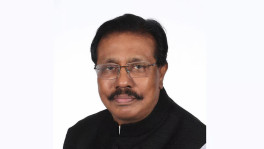
She once needed help—now she is the help
Dr Moumita Basak’s path from a struggling student to a government doctor highlights how one scholarship can ripple through countless lives

On most mornings at Nasirnagar Upazila Health Complex, the queue starts forming long before the doors officially open. Among the patients—many of them women, children, and elderly from nearby villages—stands a doctor whose own journey mirrors the struggles of those she now serves.
Dr Moumita Basak did not arrive here by accident. Her story begins in a lower-middle-class household, shaped as much by ambition as by adversity. She lost her father early in life, a turning point that left her mother to shoulder the full weight of raising the family. What followed were years defined by quiet resilience—stretching limited means to cover daily expenses, while holding on to a firm belief that education could change everything.
That belief would prove decisive.
 Keep updated, follow The Business Standard's Google news channel
After securing a strong result in her SSC examinations in 2006, Moumita faced a familiar crossroads for many students from modest backgrounds: how to continue studying when finances say otherwise. It was during this uncertain period that she came across an advertisement for a scholarship offered by Dutch-Bangla Bank. She applied, was selected, and in many ways, her path began to clear.
The scholarship did more than cover expenses—it offered continuity. With that support, Moumita completed her HSC from Dinajpur Government College in 2008, securing a GPA 5.00. She then sat for the highly competitive medical admission test and earned a place at Mymensingh Medical College.
The bank's support continued through her MBBS years, easing the financial burden that might otherwise have derailed her education. For Moumita, it meant being able to focus on what mattered most—becoming a doctor.
Years later, that ambition has translated into impact on the ground. After clearing the 39th BCS (Health) examination in 2019, she joined as an Assistant Surgeon and was posted to Nasirnagar Upazila Health Complex in Brahmanbaria. Alongside her government service, she has also completed FCPS training in Gynaecology and Obstetrics, including postgraduate work at Dhaka Medical College.
Today, her work largely centres on patients who often have limited access to quality healthcare. In a setting where resources are stretched and demand is constant, her presence represents more than just medical service—it reflects a cycle of support coming full circle.
There is a quiet symmetry to her journey. A scholarship once helped her stay in school; now, she stands at the frontline of public healthcare, helping others navigate their own vulnerabilities. Behind the white coat is not just a medical professional, but a reminder of what sustained support—both familial and institutional—can make possible.
For the patients waiting in line each day, that difference is not abstract. It is immediate, human, and deeply felt.
Sight restored, strength renewed
In a modest home in Ghoradia village, under Sadar upazila of Narsingdi, Mst. Mabia Khatun measures happiness in the simplest of ways—being able to look after her disabled son.
Life, however, had not been kind to her.
Seventeen years ago, when her husband passed away, Mabia was just 25. She was left alone with two infant sons, one of whom was physically disabled. The sudden loss pushed her into a life of uncertainty. With no steady support system, survival became her daily battle.
To keep her family afloat, Mabia took up work as an aya at a local hospital. The income was modest—barely enough to cover food and essentials. Education for her sons remained out of reach. Years passed in quiet resilience, marked by long working days and constant worry about the future.
But another setback followed. At 42, Mabia had to give up her job due to asthma complications. By then, her elder son had grown up and stepped in as the family's breadwinner, working as a van driver. Mabia stayed home, caring for her younger, disabled son and managing the household. Despite their struggles, they had found a fragile balance.
That balance was disrupted when her eyesight began to fail.
What started as slight discomfort soon turned into blurred vision. Everyday tasks became difficult. Fear settled in—what if she lost her sight completely? For Mabia, the question was not just about her own life, but about the son who depended entirely on her care.
A visit to a local ophthalmologist confirmed she had cataracts in both eyes and needed surgery. The cost—around Tk 20,000—was far beyond what her family could afford. It felt like an impossible choice between living with blindness or facing a financial burden they simply could not bear.
"I kept thinking—if I lose my sight, what will happen to my son?" she says.
Hope came through an unexpected channel.
While speaking to a local health worker, Mabia learned about a free cataract surgery programme run as part of a Dutch Bangla Bank's corporate social responsibility (CSR) initiative. Such programmes, increasingly taken up by leading banks in Bangladesh, aim to bridge critical healthcare gaps for underserved communities—especially for treatable conditions like cataracts that often go unattended due to cost.
Encouraged, Mabia attended an eye camp organised under this initiative. After preliminary examinations, doctors confirmed her condition and scheduled her for surgery. Experienced surgeons carried out the procedures successfully—at no cost.
For Mabia, it was life-changing.
Today, her vision has been restored. She can move around independently, manage her household, and most importantly, care for her disabled son—the responsibility that defines her sense of purpose.
Her story reflects the quiet but meaningful impact of CSR-driven healthcare programmes. For families like Mabia's, such interventions are not just acts of charity; they are lifelines. In her case, it meant the difference between darkness and dignity—between helplessness and the ability to care, once again, for the one person who needs her the most.