'The buildings talk on their own': In conversation with Niklaus Graber
The Swiss architect spent 14 years trying to tell the world about Muzharul Islam. The world, he says, was not looking

Niklaus Graber did not come to Bangladesh to write a book. He came, like many architects before him, to see Louis Kahn's parliament building. What followed took 14 years to fully understand — and one monograph to say out loud.
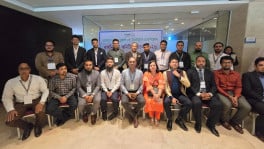
On the evening of 25 April, at the IAB Centre in Agargaon, Graber stood before diplomats, architects, and academics in Dhaka to launch 'Spaces of Belonging: The Architecture of Muzharul Islam' — the first internationally published monograph on the man widely regarded as the founder of modern architecture in Bangladesh. That such a book did not exist until 2025, and that its editor is Swiss, is itself an argument the book is trying to make.

In an interview with The Business Standard on the sidelines of the launch, Graber did not shy away from the structural question. "The architectural debate in modernity was heavily dominated by the Western world," he said.
 Keep updated, follow The Business Standard's Google news channel
"The West always claimed: we invented modernism, and later it came to the tropics. I think it is the other way around. Everything which led to modern architecture is actually borrowed from the South and East — the open plan, the porosity of buildings. If you look at the bungalow here, that is a typically modern structure."
Muzharul Islam (1923–2012) was the first trained Bangali architect in his home region. He studied in the United States and Britain, moved between the global modernist conversation and the specific conditions of post-colonial Bengal, and — critically — brought the world to Bangladesh rather than waiting to be recognised by it. He invited Louis Kahn, Paul Rudolph, and Stanley Tigerman to help shape the country's architectural future. The international conversation largely remembered the guests and forgot the host.
Graber has spent years thinking about why. His answers are not comfortable ones, at least not for the world he comes from.
"Islam did not build bombastic buildings — hotels, stadiums. He built infrastructure: schools, universities, institutes. That is difficult to sell." Then there was the man himself. "From what I heard, he had a very decent personality. He never talked about his own work. His belief was: the buildings talk on their own." Meanwhile, Balkrishna Doshi and Charles Correa held prestigious teaching positions at Western institutions — entering the circuits that produce visibility. Islam stayed home. The circuits did not come to him.
"The West believed that if they covered Doshi and Correa, this was it about the South," Graber told TBS. "There was no need for another figure. And Islam was a complex architect. A complex figure makes life difficult."
What makes the book's argument more than an act of institutional archaeology is Islam's continued relevance. His architecture — designed around airflow, cross-ventilation, light and shadow — was climate-sensitive decades before the term entered mainstream architectural discourse. Bangladesh in 2026 is one of the most climate-stressed nations on earth.
"All his buildings are based on those principles," he said. "They are wonderful machines, working in the tropical climate. Whatever occurs now in terms of increasing temperatures, Islam is still the standard. These buildings work well. Can be looked at and adapted to our times."

The word he reached for was timeless.
There is an irony, of course, in a Swiss-published book about a Bangladeshi architect arguing against the hegemonial tendencies of Western publishing. Graber does not sidestep it — the book itself raises the question.
But his 14 years in Bangladesh, his teaching at the Bengal Institute, his 'Bengal Stream' exhibition that travelled from Basel to Bordeaux to Frankfurt, suggest something more than passing interest. Whether that is enough to shift the architectural world map he critiques is a different question.
What is not in question is the gap the book fills. Islam died in 2012. He never wrote extensively about his own work. He left behind buildings — in Dhaka, in Chittagong, across a country still learning, or perhaps relearning, how to look at them.
The buildings, as he always believed, must now speak for themselves.