From Old Dhaka with love (for football)
From neighbours gathering around a single colour television in 1990 to giant screens, murals and month-long celebrations today, the World Cup has become a unique cultural festival in Old Dhaka — one that continues to unite generations of football lovers
Nazmul and the men in his family have been avidly watching football ever since West Germany lifted the trophy at the 1990 World Cup in Italy.
That year, Maradona's Argentina lost the final to the West Germans following a single second-half penalty. The disappointment of watching Argentina fail to secure back-to-back World Cup titles never quite left Nazmul, nor his family.
In those days, Dhaka's youth plastered their walls with posters of Maradona and Pelé, tucking stickers of their favourite teams and star players inside their book covers. Nazmul would source special World Cup magazines through a relative. Resources were limited, but the enthusiasm was palpable. A deep sense of community defined the era.
 Keep updated, follow The Business Standard's Google news channel
"Luckily, we had a colour television, so the neighbours would crowd into our house. Whenever Argentina, Brazil, or even Germany played, the whole neighbourhood would come alive. In that final, all of us supported Argentina," Nazmul recalls.
Four or five World Cups later, Robin's generation took up the baton. There was an open field behind the mosque on KM Das Lane in Tikatuli's Swamibagh. In 2006, and again in 2010, the entire neighbourhood would stay up late there to watch the matches.
"Our neighbour from the next building, Akmal Uncle, had a 34-inch National box television. Whenever an important match came on, we would set it up at one end of the field with a satellite connection and spread a tarpaulin on the ground," says Robin, who was eight or nine at the time.
Another decade on, the atmosphere, logistics, and vibrancy of watching the World Cup had completely changed for Robin and the people in his para (neighbourhood). Children were always in the front row, whilst projectors and giant screens had replaced televisions in the lanes and neighbourhoods of Dhaka.
As soon as a World Cup approached, the walls of residential buildings and narrow alleys would be covered with flags, graffiti, and alpana. Whose flag was bigger, who could hang theirs the highest — the rivalry was fierce. Before long, flash mobs set to World Cup anthems began appearing on Dhaka's streets.
However, during the 2022 World Cup, and now ahead of the 2026 tournament in North America, the generations have merged — Nazmul from the 1990s, Robin from the 2000s, and today's children have all come together.

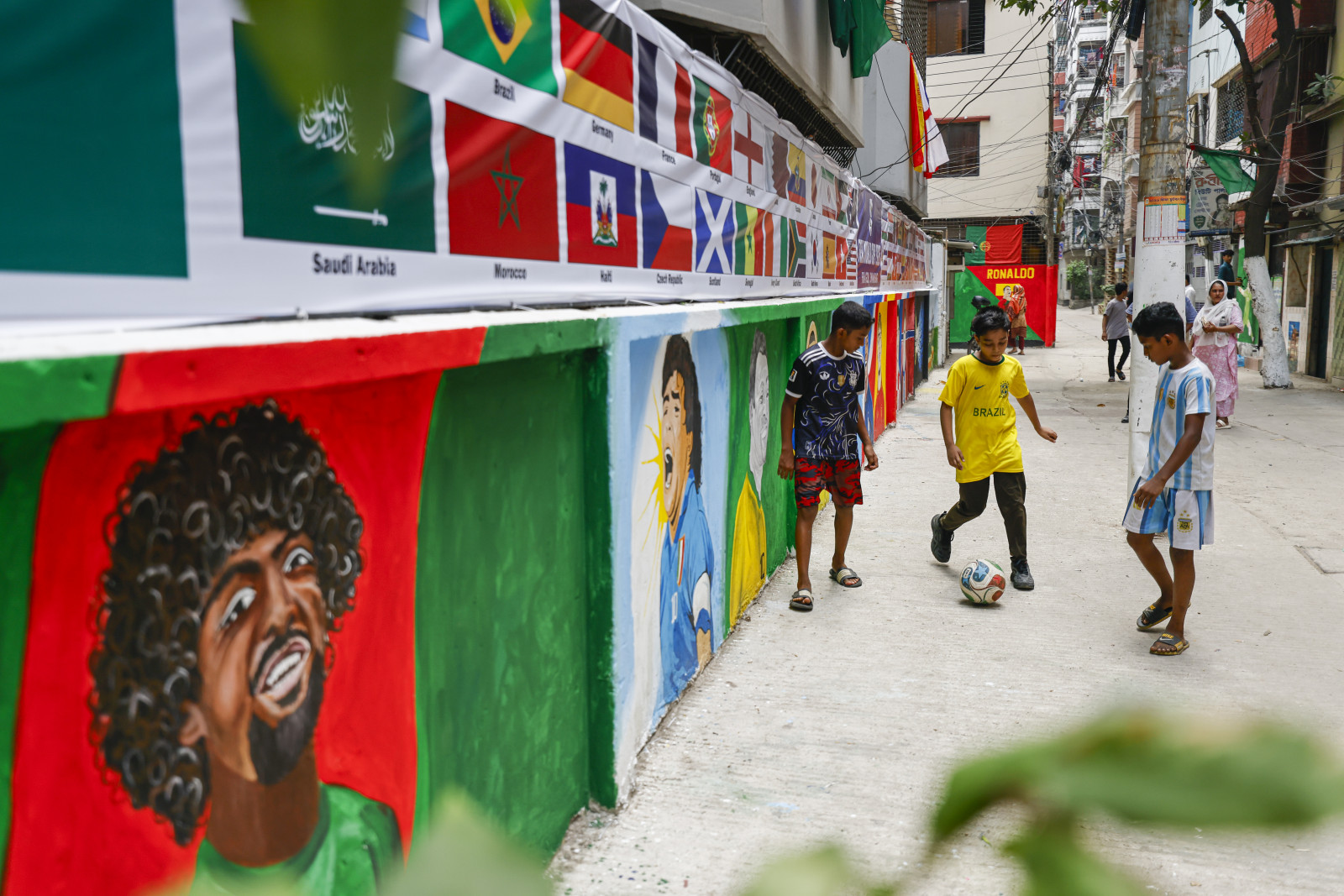
One of the alleys on KM Das Lane has even been named 'FIFA Goli' on Google Maps. The place is now vibrating with energy, ready for a month of absolute madness, the local children say.
Looking from one end of the lane to the other, one can see the flags of participating countries painted across the walls, large murals of star footballers, national flags draped from residential buildings, and Western-style street art covering the road surface.
"Throughout the World Cup, there'll be a projector in FIFA Goli, a futsal tournament, custom jerseys for the children, and plenty of food. The entire lane will buzz day and night for a full month," says Robin, one of the organisers.
The story of FIFA Goli's celebrations has already travelled beyond Bangladesh's borders. The organisers mentioned that international media outlets such as Reuters and the BBC have interviewed them, whilst a popular New York magazine has also featured their initiative. Images of their 2022 World Cup festivities were even published on FIFA's official Facebook page.
This year's preparations cost the group roughly Tk3 lakh, every taka of which was raised internally. "The money came from the local elders and our own friends. We haven't taken on a single sponsor," Robin adds.
When I visited, preparations were still in full swing. Children darted between adults; some pitched in with the work, whilst others swept the lane or scrubbed the walls clean. The labour, it turns out, is shared by everyone, young and old alike.
Work began in the weeks leading up to Eid-ul-Adha last month. After roughly twenty days and nights of effort, the lane is set to be ready the day before the tournament kicks off. Mural artist Zahid Hasan completed the entire project with just four assistants, having also led the artwork in 2022.
According to the organisers, the sole purpose of the initiative is to celebrate the World Cup as a grand festival in their own unique way. They aim to showcase Bangladesh's love for football to the rest of the world and pass that passion on to the next generation, ensuring that KM Das Lane's 'FIFA Goli' endures for years to come.
Nazmul, who personally bears a large share of the event's expenses, explained, "We didn't really think about the money. We just wanted everyone to come together and enjoy the World Cup."

Where it all began
This kind of neighbourhood celebration did not originate on KM Das Lane. In Old Dhaka, it first began in Loboner Goli (Salt Lane) in Koltabazar. By local accounts, no other part of Old Dhaka has managed anything quite like it since.
During the 2014 World Cup in Brazil, One Degree Initiative and Janala Bangladesh jointly organised the first 'World Cup Goal-e Fest' in Loboner Goli. That one-day celebration at the water pump crossing was so electric that it gave the lane a new identity. Locals began calling it 'World Cup Goal-e' — a clever play on the Bengali word for alley (goli) — and the name stuck.
Then came the 2018 Russia World Cup, and Loboner Goli erupted once again. Graffiti and street art covered every surface from one end to the other — shopfronts, shutters, residential walls, and gates; nothing was spared.
Bicycle stunt performances and football exhibitions ran throughout the day. Flash mobs, human towers, and colour play drew thousands of young people into the lane. The entire street dissolved into music, dance, and barely contained excitement.
Remarkably, it all came together in just two days. Artists, cartoonists, and volunteers worked through the night to ensure every wall was painted by dawn.
That year, too, the celebrations found an audience well beyond Bangladesh. International media carried the story as far as Latin America, and FIFA's official Facebook page shared photographs from the festival.
This year, however, Loboner Goli is quiet. There was no celebration in 2022 either, and the walls have gone largely bare. A few remnants of the 2018 murals are all that remain in certain corners, faded and peeling.
Then and now
Every World Cup season, the football fever of a tournament played thousands of miles away somehow grips Dhaka's residents as if it were their own. Allegiances are declared anew across every age group and neighbourhood. Arguments break out anywhere, with anyone, over whose team has the edge.
Mozammel Haq, a Sutrapur resident in his fifties, spots a friend and calls out, "What do you say? Can your Brazil manage it this year?" His friend fires back, "Just make sure you lot hold on to your dignity!" Afterwards, Mozammel settles into his own World Cup story.
"I started watching football during the 1986 World Cup. That was the year we got our first black-and-white television. From that moment, I've been an Argentina supporter. I haven't switched sides since," he says.
He explained that television sets were scarce at the time, which is why large numbers of people would gather at his house to watch the matches. However, viewing wasn't always smooth. Antennas often malfunctioned, or power cuts would disrupt the broadcast, leaving everyone deeply disappointed.
There were also far fewer organised community screenings in neighbourhoods than there are today. Consequently, the World Cup experience wasn't quite as deeply community-centred as it has become.
Over the following decade, televisions became common in homes, neighbourhood clubs, and even tea stalls. With this, the excitement of watching matches spread throughout local areas, whether outdoors or inside people's homes. By the 1990s, large groups gathering to watch matches had become a familiar scene across neighbourhoods.
From the 2000s onwards, World Cup celebrations in Old Dhaka, as well as greater Dhaka, grew even more vibrant. During this decade, the widespread use of satellite dishes led to the mass adoption of colour televisions.
As a result, televisions began to be moved out into the open spaces of neighbourhoods during the tournament. Public participation surged. The practice of hoisting large flags on rooftops also began, and Dhaka was soon blanketed in the colours of people's favourite teams. Alongside this, buying and wearing team jerseys became commonplace.
The rest of the story is well known. Eventually, everyday match viewing became confined to mobile phone screens and high-resolution smart televisions.
However, the responsibility for organising major events was no longer limited to neighbourhood residents.
With corporate sponsorships, the scale of these celebrations expanded further. A major transformation arrived with the introduction of projectors and giant screens, bringing the grand spectacle back into the public square.